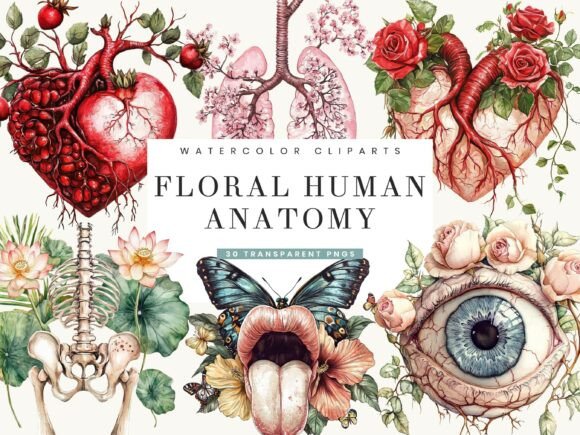
Watercolor Floral Human Anatomy: Merging Artistic Elegance with Scientific Precision
The intersection of art and science has long fascinated creators, educators, and medical professionals alike. In recent years, a specific aesthetic has emerged that captures this duality with remarkable grace: Watercolor Floral Human Anatomy. This style blends the clinical accuracy of anatomical illustration with the soft, organic beauty of botanical watercolors. It is not merely a trend but a distinct visual language that transforms sterile medical diagrams into evocative pieces of art. For designers, educators, and hobbyists, understanding the nuances of this style is essential for selecting the right resources for their projects.
When evaluating digital assets or artistic approaches, it is crucial to look beyond surface-level aesthetics. The appeal of watercolor floral anatomy lies in its ability to humanize the body while celebrating its complexity. Unlike traditional medical illustrations, which prioritize stark clarity and neutral tones, this approach introduces warmth, texture, and metaphorical depth. Whether you are designing educational materials, creating personal stationery, or developing unique decor, knowing how this style compares to alternatives can help you make an informed decision.
Defining the Aesthetic: What Sets Watercolor Floral Anatomy Apart
At its core, Watercolor Floral Human Anatomy is a hybrid genre. It combines two distinct visual traditions: the precise, structural representation of human organs and systems, and the loose, fluid nature of watercolor painting adorned with floral elements. The result is a juxtaposition of the internal and the external, the mechanical and the natural.
What makes this style distinct is its emotional resonance. Traditional anatomical charts are designed for identification and study, often stripping away context to focus on function. In contrast, floral anatomy reintroduces context by suggesting growth, life, and fragility. The inclusion of flowers—such as roses, peonies, or wildflowers—softens the potentially graphic nature of anatomical imagery. This makes the content more accessible to a broader audience, including those who might find standard medical illustrations unsettling.
From a technical standpoint, high-quality examples of this style rely on transparent backgrounds and high-resolution files. For instance, a bundle offering 30 PNG files at 300 DPI ensures that the delicate gradients of the watercolor remain crisp when printed or scaled. This technical fidelity is vital for maintaining the integrity of the art, whether it is used in a small journal entry or a large poster.
Comparing Styles: Watercolor vs. Vector and Realistic Illustrations
When choosing visual resources for a project, creators often face a choice between several illustrative styles. Understanding the tradeoffs between watercolor floral anatomy and other common formats is key to selecting the best fit.
- Vector Graphics: Vector illustrations are scalable without loss of quality and offer clean, sharp lines. They are ideal for logos or infographics requiring strict uniformity. However, they often lack the texture and organic feel of watercolor. If your goal is to evoke emotion or create a handcrafted aesthetic, vector anatomy may feel too rigid or commercial.
- Photorealistic Medical Illustrations: These are the gold standard for academic and clinical settings. They provide unmatched accuracy and detail. Yet, they can appear cold or intimidating in non-clinical contexts. For projects like greeting cards, wellness blogs, or decorative art, photorealism may be overly intense. Watercolor floral anatomy offers a gentler alternative that retains recognizability without the clinical sterility.
- Line Art and Sketches: Minimalist line drawings are popular for their simplicity and modern appeal. They work well for tattoos or subtle branding. However, they may lack the visual impact needed for statement pieces. Watercolor adds depth, color, and dimension, making it a better choice for projects that require a focal point or a richer visual narrative.
The decision ultimately depends on the intended message. If precision and neutrality are paramount, realistic or vector styles may be superior. If the goal is to inspire, comfort, or decorate, the softness of watercolor floral anatomy provides a unique advantage.
Practical Applications and Best-Fit Scenarios
The versatility of Watercolor Floral Human Anatomy allows it to serve diverse purposes. Its suitability varies depending on the medium and the audience. Here are some practical scenarios where this style excels:
Educational and Wellness Materials
In fields such as yoga, physical therapy, and holistic health, the connection between the body and nature is a central theme. Using floral anatomy in posters, brochures, or digital content can reinforce this message. It makes anatomical education less intimidating for students or clients, encouraging engagement through beauty rather than fear. For example, a diagram of the heart surrounded by blooming flowers can symbolize vitality and care, aligning perfectly with wellness branding.
Creative Crafts and Stationery
For individuals engaged in junk journaling, scrapbooking, or card making, these clipart bundles offer ready-made elegance. The transparent backgrounds of high-definition PNG files allow for easy layering over textured papers or other design elements. Users can create unique greeting cards for birthdays, get-well wishes, or memorials, where the symbolism of life and decay is handled with sensitivity and artistry. The hand-painted look adds a personal touch that mass-produced stickers often lack.
Interior Decor and Art Prints
Home decor trends increasingly favor biophilic design, which integrates natural elements into living spaces. Watercolor floral anatomy fits seamlessly into this aesthetic. Prints featuring anatomical hearts, lungs, or brains intertwined with botanicals can serve as conversation starters in living rooms, offices, or studios. They bridge the gap between scientific curiosity and artistic expression, appealing to a wide demographic of adults aged 20–50 who value both intellect and aesthetics.
Evaluating Quality: Key Decision Factors
Not all digital assets are created equal. When sourcing Watercolor Floral Human Anatomy clipart or illustrations, several factors should guide your evaluation:
- Resolution and DPI: Ensure the files are at least 300 DPI. Lower resolution images may appear pixelated when printed, ruining the delicate watercolor effects. High-definition quality is non-negotiable for professional results.
- Background Transparency: Look for PNG files with transparent backgrounds. This feature is essential for layering and integrating the artwork into various designs without awkward white boxes or manual editing.
- Artistic Consistency: A cohesive bundle should maintain a consistent style across all images. Variations in color palette, brushstroke technique, or floral types can disrupt the visual harmony of a project. Hand-painted designs often offer more uniqueness than digitally generated counterparts.
- Licensing and Usage Rights: Always check the license terms. Some assets are for personal use only, while others allow commercial applications. Understanding these boundaries prevents legal issues and ensures ethical usage.
Limitations and When to Choose Alternatives
While watercolor floral anatomy is versatile, it is not a universal solution. There are situations where this style may fall short. For strictly academic publications, peer-reviewed journals, or clinical patient education materials, the artistic embellishments may distract from the scientific data. In these cases, standard medical illustrations remain the appropriate choice.
Additionally, if a project requires extreme scalability, such as large-format billboards or vehicle wraps, vector graphics may be more practical. While high-resolution PNGs are suitable for most print and digital uses, vectors offer infinite scalability without file size bloat.
Furthermore, consider the audience’s expectations. In highly conservative or traditional corporate environments, the whimsical nature of floral anatomy might be perceived as unprofessional. Context matters, and aligning the visual style with the brand’s voice is crucial.
Making the Right Choice for Your Project
Selecting the right visual resources involves balancing aesthetic preference with functional requirements. Watercolor Floral Human Anatomy offers a compelling blend of elegance and originality, making it ideal for projects that benefit from a human touch. It is particularly well-suited for creators who want to stand out in crowded markets like stationery, wellness coaching, or independent publishing.
By comparing this style against vector, realistic, and minimalist alternatives, you can identify where it adds the most value. Remember to prioritize technical quality, such as HD resolution and transparent backgrounds, to ensure versatility. Whether you are designing a heartfelt greeting card or an engaging educational poster, this artistic approach can transform complex biological concepts into accessible, beautiful visuals. Ultimately, the best choice is one that aligns with your project’s goals, resonates with your audience, and reflects your creative vision.